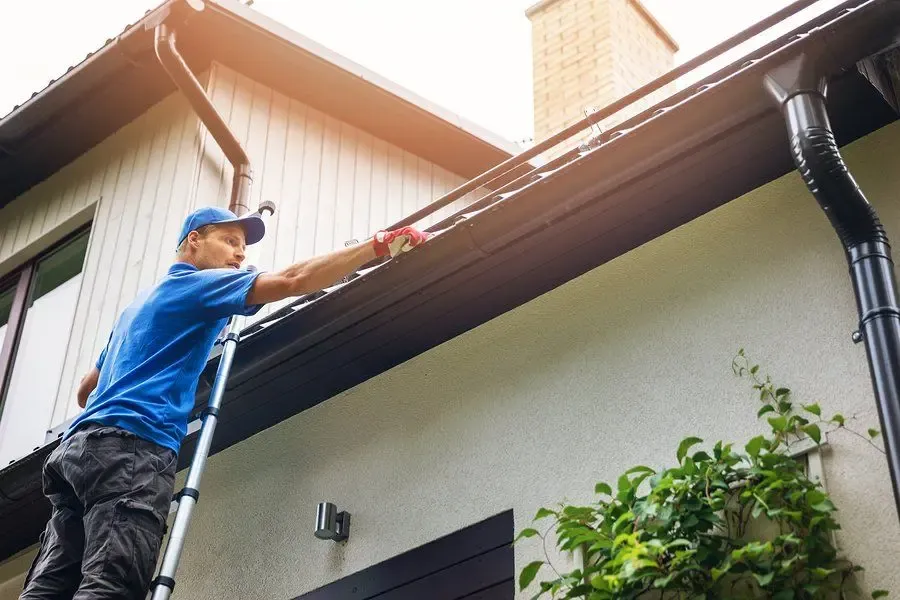
Loveland Gutter Work Is About Direction as Well as Flow
An open gutter can still deliver water to the wrong place. On a sloped Loveland property, the downspout exit deserves the same attention as the channel. Water released beside the foundation or uphill of a retaining wall can work against the reason the system exists.
Cincinnati-area clay-heavy soil drains slowly. Gutter cleaning cannot diagnose soil, foundation, or site-drainage conditions. It can make sure the roofline path is open, the lower sections stay connected, and an obviously poor discharge direction is not ignored.
Work Backward From the Wet Spot
Overflow at the roof edge
Watch the downspout beneath the spill. If it is quiet, start at the outlet and the first elbow. If it is flowing, the issue may involve a local low section, concentrated valley water, or a restriction that still allows partial movement.
Water behind the channel
A wet fascia stripe can point to a roof-edge or attachment issue rather than debris alone. Clear the gutter before judging it, but do not assume front-seam sealant will solve water entering from behind.
Wet ground at the exit
If the upper system is working, inspect where the downspout ends. Look at the grade and nearby retaining features. An extension or redirection should not create a trip hazard or simply move water toward another structure.
Leaves Turn Into Outlet Sludge
Oaks, maples, and sycamores provide broad fall leaves and a finer spring round of pods, catkins, and helicopters. The spring material catches grit and knots together at outlet openings. Ohio Valley humidity keeps shaded piles wet, accelerating the breakdown into sludge.
Screens are not immune. Large leaves may stay outside while smaller particles pass through. Fine mesh can hold a layer on top. Any gutter guard needs a service plan and visible access to the problem areas.
Cleaning Has a Clear Boundary
Gutter cleaning removes loose and compacted material, exposes accessible outlets, and checks the upper downspout path. Debris should leave with the work. Cleaning also removes weight so the empty channel can be read.
A sag that remains, a separated joint, or a loose downspout connection is repair work. A deteriorated run with failures in several places may be a replacement candidate. Neither conclusion should be made while the system is still buried under wet debris.
Hillside Access Can Change by Elevation
The uphill side of a house may offer a low reach while the downhill side adds substantial working height. Do not use makeshift ladder leveling or climb onto a steep roof to reach the far edge. Soft soil and side slopes can shift under load.
DIY is reasonable only where the gutter is low, the ground is firm and level, overhead space is clear, and another adult is nearby. Keep the body between the ladder rails and move the setup often.
Inspect After Each Debris Cycle
Use spring and late fall as checkpoints. If the gutter is open and rain reaches a suitable discharge point, no cleaning is needed yet. Focus later inspections on shaded runs, valley outlets, and sections above slopes or retaining walls.
Call (513) 982-5740 for a free Loveland quote. Describe the story count on each side, ground slope, guard type, and both the overflow location and downspout exit. The bottom of the system may tell as much as the top.