Wyoming Rooflines Reward a Careful Hand
Some century homes in Wyoming retain original half-round gutters. Those channels have a visible shape and attachment system that should not be treated like generic scrap metal. Cleaning removes wet leaves and sludge; it should not involve levering against old brackets or forcing a tool through a distinctive outlet.
Tall two- and three-story rooflines add an access issue. A short gutter run can still require a serious setup, especially where the ground slopes away. The safest decision may be to leave the ladder on the truck until the full elevation and footing are understood.
Organic Material Hides the Real Condition
Mature deciduous canopy creates broad autumn leaves, then a second spring round of catkins, pods, and maple helicopters. Fine debris catches grit and packs around outlets. Shade and Ohio Valley humidity help the lowest layer break down into sludge.
That weight can make a weak run look worse. Remove it before judging alignment. Once the channel is empty, a persistent sag, moving bracket, or opened seam can be read as a gutter repair issue rather than blamed on the clog alone.
Clear without prying
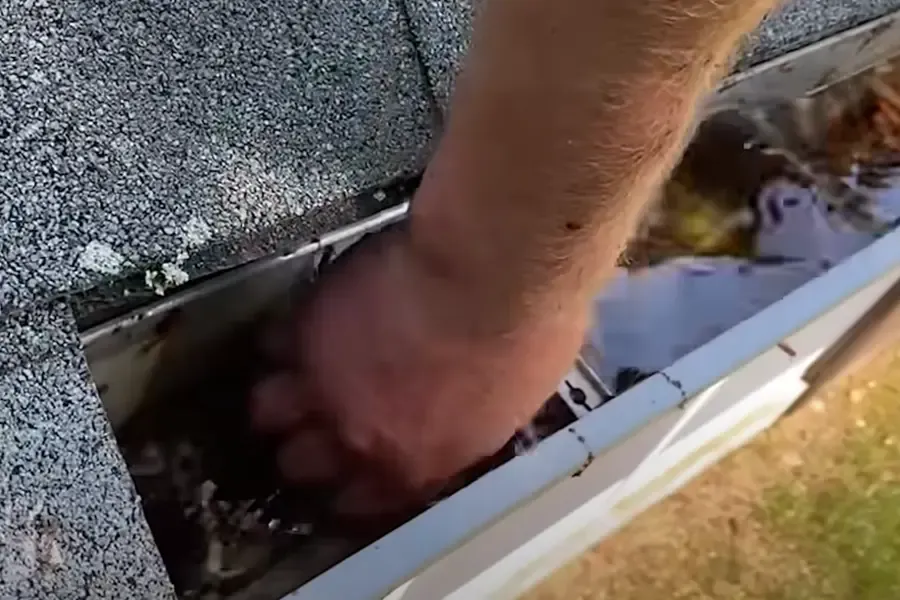
Wet material should be scooped and controlled in short sections. The outlet opening can be exposed by removing the debris around it. Do not drive metal tools into an elbow or use the gutter lip as a brace.
Keep the part visible
Older half-round components may contribute to the roofline’s appearance. If one joint has failed and the surrounding material is sound, focused work may preserve more of the system. If deterioration runs through several sections, repeated patching may not be a fair recommendation.
Follow the downspout connection
Distinctive upper gutters still rely on ordinary drainage logic below. The downspout must remain connected and release water away from the immediate foundation area. On clay-heavy or sloped ground, discharge direction matters.
Guard Decisions on Older Gutters
A guard should not be added merely to avoid looking at the channel. Fit, appearance, debris type, and future service access all matter on half-round systems. A generic cover may be a poor match even when it would fit a standard profile.
Open screens can admit fine spring debris. Fine mesh can hold material on top. Surface-tension covers need a clean, aligned edge. If a low run is safely reachable, keeping it open and cleaning only when necessary may be the simpler approach. See the full gutter guard guide before deciding.
Inspect at the End of Each Drop
Check after spring seeds and catkins have finished and after the bulk of autumn leaves are down. Do not order work solely because the calendar says so. A safely visible channel that is empty and flowing can wait.
Before freezing weather, a known blockage should be cleared so meltwater is not held in the gutter. Freeze–thaw cycles can add weight and work at already weak seams. Cleaning removes that avoidable load but cannot repair a joint that has opened.
Do Not Underestimate the Downhill Side
DIY work is reasonable only where the edge is low and the ladder can stand on firm, level ground. The downhill elevation may be much taller than the front. Never use makeshift blocks, stand above the ladder’s intended working position, or walk a steep roof to reach another section.
For a free Wyoming quote, call (513) 982-5740. Mention the story count, ground slope, half-round shape, visible brackets, guards, and what happens during rain. Photos from the ground are enough to start.